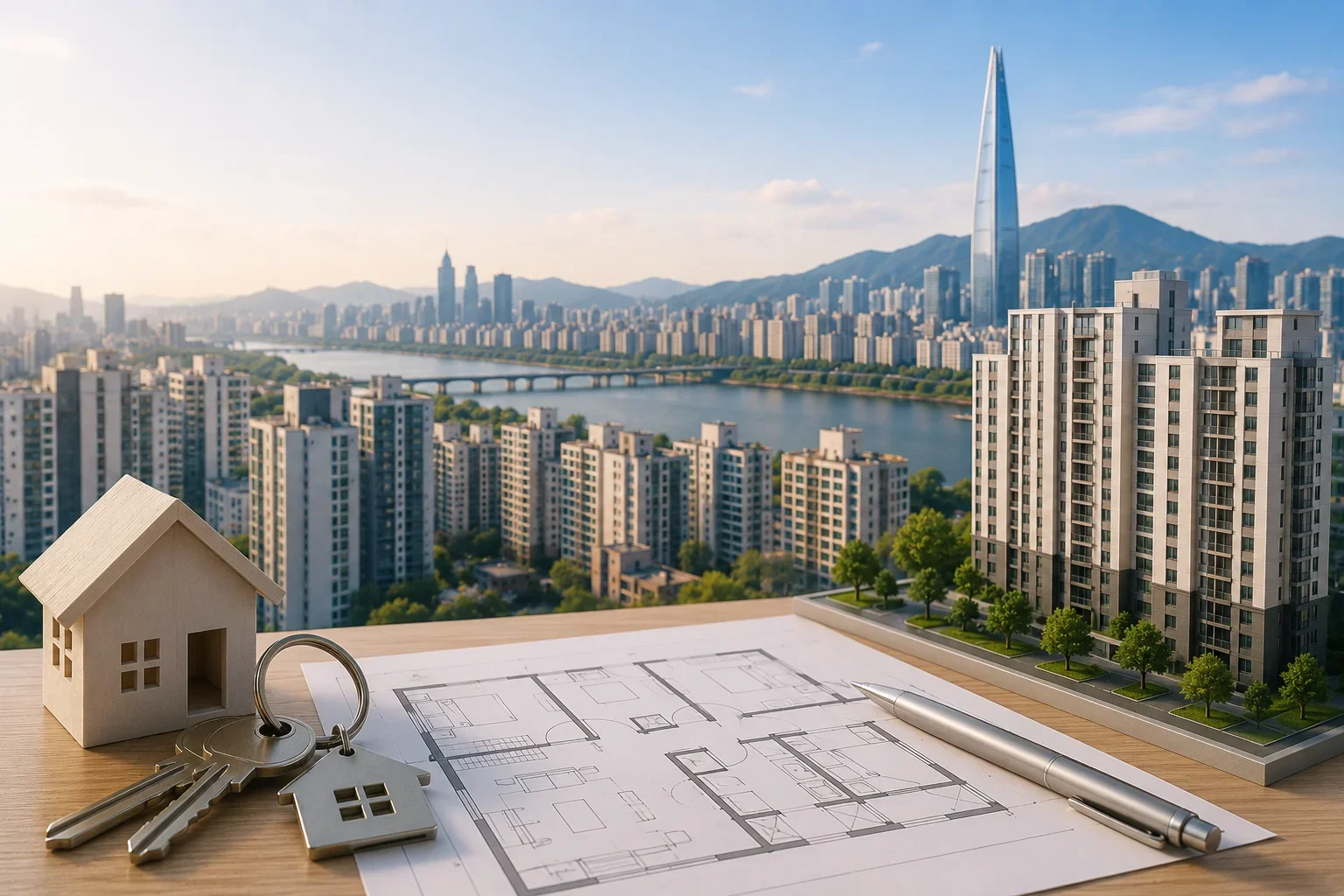
Korea's cities look the way they do for a reason. Rows of identical high-rise apartment blocks stretching to the horizon are not just an aesthetic choice — they are the answer to a very specific question: how do you house millions of people in a mountainous country with limited flat land? We find this story fascinating, and we love sharing the details with travellers who want to understand Korean life beyond the tourist trail.
Types of Housing in Korea
Korean housing divides into two broad categories: detached houses (단독 주택, dandok jutaek) and collective housing (공동 주택, gongdong jutaek). The distinction matters more than it seems — it determines ownership structure, legal classification, and even how disputes between neighbours are handled.
Category | Type | Key features |
|---|---|---|
Detached (단독) | Standard detached house | One household, fully independent. |
Detached (단독) | Multi-household house (다가구, dagagu) | Multiple units in one building, max 3 floors, single owner. Owner rents out all units. |
Collective (공동) | Multi-unit house (다세대, dasedae) | Similar layout to dagagu but each unit has a separate owner — can be bought and sold individually. |
Collective (공동) | Row house / villa (연립, yeonlib) | Collective housing, 4 floors or fewer. |
Collective (공동) | Apartment (아파트, apateu) | Collective housing, 5 floors or more. The most common housing type in Korea. |
One point that catches many people out: a 다가구 (dagagu) building looks from the outside almost identical to a 다세대 (dasedae) building, but legally the dagagu is classified as detached housing — because the whole building has one owner. The dasedae is collective housing because each unit can be owned separately. This distinction matters enormously if you're buying rather than renting.
Why Apartments Became Korea's Default
Before the 1960s, most Koreans lived in low-rise detached homes or traditional hanok (한옥). Then rapid industrialisation pulled tens of millions of people into cities. Seoul's population climbed toward ten million — and there simply was not enough low-rise land to house everyone.
The government response was massive apartment construction. Blocks went from 5 storeys to 10, then to 30 and beyond. Today apartments dominate because they offer something Koreans genuinely value: proximity to metro lines, schools, hospitals, and shopping — all the urban infrastructure concentrated in one place.
There is also a financial dimension. Apartments in Korea are widely seen as a reliable investment vehicle — their prices have historically risen faster than those of detached houses in the same area. This perception reinforces demand in a self-fulfilling loop.
The downside of density is 층간소음 (cheunggansoseum) — noise between floors. Disputes over footstep sounds, children running, and late-night noise are a genuine social problem in Korea, occasionally making national news in serious cases.
The Changing Face of Korean Housing
A few other trends are reshaping the market:
- Single- and two-person households are growing rapidly, driving demand for 원룸 (wollum) studios, 오피스텔 (officetel) units, and compact apartments.
- A counter-movement of city dwellers seeking nature is fuelling interest in 한옥 (hanok) and suburban houses. Modern "fusion hanok" preserves the tiled-roof exterior while fitting a contemporary kitchen and bathroom inside.
- Historically, the grand 기와집 (giwajip) — tile-roofed hanok — belonged to the wealthy and noble classes; the 초가집 (chogajip) thatched-roof house was the common people's home.
The Three Ways to Live in Korea: Jaga, Jeonse, and Wollse
Finding a home in Korea means choosing one of three residential arrangements. Understanding the difference is essential before you sign anything.
Arrangement | Korean | How it works |
|---|---|---|
Ownership | 자가 (jaga) | You own the property outright. |
Jeonse | 전세 (jeonse) | You pay the landlord a large lump-sum deposit — typically 50–80 % of the property value — and live there with no monthly rent for the contract period. The deposit is returned in full when you leave. Standard contract: 2 years. |
Monthly rent | 월세 (wollse) | You pay a smaller deposit plus monthly rent. Lower up-front cost, higher ongoing cost compared to jeonse. |
Jeonse is genuinely unique to Korea. The landlord uses your deposit as an interest-free loan, investing or saving it during the tenancy. You get free accommodation; they get liquidity. It sounds odd until you realise Korea's historically high interest rates made this arrangement financially logical for both sides. Today jeonse remains widely used, though rising housing prices and falling interest rates are gradually shifting more tenants toward wollse.
Tenant Protections You Need to Know
Korea has a set of housing protections that are unusually strong by international standards — but only if you know how to activate them.
The 2+2 Automatic Renewal Rule
A standard jeonse or wollse contract runs 2 years. Under the 임차인 보호법 (tenant protection law), if the tenant simply notifies the landlord that they wish to extend, the contract automatically renews for a further 2 years — giving a guaranteed total of 4 years. The landlord cannot refuse. This is enshrined in law.
Confirming Your Deposit: 확정일자 (Hwakjeong-iljja)
This is the single most important administrative step for any renter in Korea. On moving day — or as soon as possible after signing your lease — you visit the local 행정복지센터 (Haengjeong-bokji senteo), the community welfare centre, and ask for a 확정일자 (hwakjeong-iljja) stamp on your lease contract. The fee is 600 won — effectively free.
What does this stamp do? It gives your deposit first-priority creditor status. If your landlord goes bankrupt or the property is seized by a bank, your deposit is returned before banks and other creditors receive anything. Without this stamp, you join the general queue of creditors — and in the worst case, you recover nothing.
This is not a formality. We strongly encourage any long-stay visitor or resident to take this step on moving day.
Public Rental Housing (LH) — Open to Foreigners
Korea's national public housing body is LH (한국토지주택공사, Korea Land & Housing Corporation). LH-managed properties are available to eligible foreign nationals — unlike Seoul city-run programmes (such as SH), which are generally restricted to Korean citizens. Competition is intense (sometimes hundreds of applicants per unit), but it is a legitimate option worth investigating for long-term residents.
Finding a Home: Practical Steps
Real estate agencies (부동산 중개업소, budongsan jungaeopso) are the standard route. All legitimate agencies are run by a licensed 공인 중개사 (certified real estate agent). They verify property documents, prepare contracts, and explain legal obligations — an invaluable service when you're navigating a system in a foreign language.
When choosing where to live, Koreans typically weigh four factors in this order:
- Transport — commute convenience is paramount.
- Education — proximity to good schools matters enormously, especially for families.
- Residential environment — quiet, clean, safe surroundings.
- Amenities — supermarkets, hospitals, and pharmacies within easy reach.
One practical note: 포장 이사 (pojang isa), or "packed moving", is a full-service moving option where a company packs all your belongings, transports them, and unpacks and organises everything at the new address. It is widely used and surprisingly affordable compared to equivalent services elsewhere.
A Quick Vocabulary Reference
Korean term | Romanisation | Meaning |
|---|---|---|
임대 | imdae | Lending out (landlord's side) |
임대인 | imdaein | Landlord |
임차 | imcha | Borrowing for use (tenant's side) |
임차인 | imchain | Tenant |
임대차 계약서 | imdaecha gyeyakseo | Lease agreement |
Korean housing law and culture reward those who understand the system. Whether you are visiting for a few months or settling in long term, knowing the difference between a 다가구 and a 다세대, understanding what jeonse really means, and getting that 확정일자 stamp could save you — or someone travelling with you — a great deal of money and stress.