subject
A group transfer (without a guide) is included in the program. A Korean-speaking driver will meet guests at the airport with a name sign. There may be a short wait for other participants before departure.
Fixed-date group tour
Seven days, three cities, a thousands years of Korean history — from Seoul's royal palaces to a Silla tomb you can walk inside, to Busan's salt-aired harbour at the edge of the sea.
Photographs
Features
Day by day
A group transfer (without a guide) is included in the program. A Korean-speaking driver will meet guests at the airport with a name sign. There may be a short wait for other participants before departure.
You are welcome to arrive in Korea before the official start of the program. Upon request, we can assist with booking extra nights at the hotel prior to the tour.
09:00 · duration, hours: approximately 5
Walking tour of Seoul's historic center. Explore Insadong, Jogyesa Temple, Gyeongbokgung or Changdeokgung Palace (Tuesdays), Samcheong-dong, Gwanghwamun Square — a perfect blend of tradition and modernity.
Insadong is famous for the abundance of souvenir shops, traditional restaurants and tea houses, boutiques.
Insadong-kil Pedestrian Street is the central street of the area.
Often you can see street performances - traditional Korean samul-nori percussion quartet or martial arts tekkyon, taekwon-do or performances of youth groups in the fusion style, etc.
In the heart of Seoul stands Jogyesa — the head temple of Korea’s largest Buddhist order.
Small in scale but rich in atmosphere, it changes with the seasons: lotus lanterns in spring, bright chrysanthemums in fall, and peaceful stillness in winter.
No matter the time of year, it’s a place of quiet reflection.
The main palace of the Joseon dynasty — rebuilt more than once, but never lost its grandeur.
Its perfect symmetry, royal guard ceremony, and the chance to wear a hanbok turn your visit into a journey through time.
Winding lanes, wooden hanoks, hidden cafés — this is where time slows down.
Samcheong-dong charms with its hills and galleries, while Bukchon preserves the everyday beauty of Joseon-era homes.
Together, they offer a quiet, romantic escape — a walk through history lined with soft light and gentle stories.
The complex of the central Gwanghwamun Square in front of the Gyeongbokgung Royal Palace, which is the compositional center of the capital of Korea, offers amazing views of Seoul: on one side is the main residence of the kings of the Joseon state (now a museum). But along the Sejong-daero Avenue, departing from the square, there are high-rise modern buildings: government, embassies, Kyobo - the largest bookstore in Korea. Further down the avenue we can see the Seoul City Hall and still further - the Great South Gate of Namdaemun (National Treasure No. 1).
09:00 · duration, hours: approximately 4
This route presents modern southern Seoul: Gangnam, COEX, the visual culture of new Korean brands, and the city seen from the height of Lotte World Tower. It is not a tour of “old Korea,” but of scale, style, pop culture and architectural spaces that shape Seoul’s image today.
A fantastical project by IICombined, a company that brings together such remarkable brands as Gentle Monster, Tamburinus, Atiissu, and Nuflaat.
All of these brands can be explored within a grotesque, immersive space that offers countless opportunities for creating striking, high-quality selfies — with robots, creatures from other worlds and dimensions, as well as with the brand installations themselves.
The tallest building in Korea is Lotte World Tower. 123 floors and 555 meters high. And on the highest floors is Seoul Sky - an observation deck.
Floor with transparent floor; the floor where you can go outside, the floor with cafes and souvenirs. Even the elevator that takes you to Seoul Sky is a separate attraction with Guinness records to boot.
This statue is a must-visit for fans of PSY's global hit "Gangnam Style." It's a playful spot to capture fun and memorable photos, especially if you strike the famous horse dance pose!
This breathtaking library in COEX Mall features towering bookshelves and a stunning architectural design. It's an ideal spot for book lovers and those looking for a unique photo backdrop. The natural lighting and open space make it perfect for both wide shots and close-ups.
13:58 · duration, hours: approximately 3
16:06 · duration, hours: approximately 3
Though made anew, it is a nice and quite picturesque place, especially at night.
Just a few years ago, Hwangnam-dong began to come alive — as it grew popular among young people, cozy cafés, boutiques, bookstores, and souvenir shops began to appear. This is how Hwangridan-gil was born — a street that today feels inseparable from Gyeongju itself.
In the evening, it’s especially magical: from a rooftop café, you can watch the sunset over a sea of traditional Korean hanok rooftops. Narrow alleyways, the warm glow of shop windows, and the absence of high-rises create an atmosphere of charm and nostalgia.
Hwangridan-gil is located next to the ancient Daereungwon tombs and is protected as part of Korea’s cultural heritage.
Cheomseongdae is one of the oldest observatories in the world (7th century). The tower of the observatory is full of symbolism: the total number of hewn stones from which it is built; the number of rows of these stones before and above the small window, the shape of the stones... Reasonable Silakians paid attention to everything.
Cheomseongdae was built under the reigning Queen Seondok - one of three in the history of Silla. The queen ended up in a drama that, of course, was filmed in Gyeongju.
09:00 · duration, hours: approximately 3
High on the forested slopes of Mount Tohamsan above ancient Gyeongju, two UNESCO World Heritage sites tell a single story of karma, rebirth, and filial devotion: the grotto sanctuary of Seokguram, whose serene granite Buddha is widely regarded as the finest stone sculpture in Korean Buddhist art, and the grand temple complex of Bulguksa, whose cloud-bridges and paired stone pagodas have anchored Silla-dynasty worship since the 8th century.
The Buddha statue in this small temple in an artificial grotto is considered the most elegant in All of Korea! The grotto is located on the slope of Mount Tkhohamsan, where the winding serpentine of the mountain road leads.
The walk to the temple through the mountain forest from the parking lot takes about 15-20 minutes; depending on the weather, either a mysterious foggy landscape awaits us (fogs are not uncommon on this mountain), or breathtaking bird's-eye views of the thousand-year-old Gyeongju.
In the grotto, which is formally the hermitage of the Bulguksa temple, located below the slope, the dominant position is occupied by the above-mentioned statue of Buddha, sitting in a lotus position on a pedestal in the shape of a lotus. Around it at different heights are bas-reliefs and statues of bodhisattvas, arhats, Indra and Brahma, the Four Heavenly Kings.
If the group agrees, we can go down the mountainside to the temple of Bulguksa.
The main Buddhist temple of United Silla, it is now a place of pilgrimage for many guests of Korea.
The temple was built in 774 under the leadership of the premier of the state of Silla, Kim Taesong. Legend has it that Bulguksa was dedicated to the parents of the current, so to speak, Kim Taesong. While Seokguram, the temple-hermitage under Bulguksa, was intended for Kim Taesung's parents from his previous incarnations.
In 1995, Bulguksa and Seokguram were inscribed on the UNESCO World Heritage List.
13:00 · duration, hours: approximately 4
What did people dream about in the Stone Age? In Korea, in the former capital of whalers, Ulsan, they dreamed, apparently, about whales. Most of the composition of the famous Pangude rock, decorated with rock carvings (petroglyphs), well preserved to this day, is dedicated to whales.
If time permits, we will walk along the picturesque river and up to the second (chronologically - the first) rock with petroglyphs - in the area of the village of Cheongjong-ri. In addition to the Neolithic petroglyphs themselves, a rock at Cheongjeong-ri has preserved a curious Silla era inscription on a hanmun.
It is a unique museum in Korea specializing in petrogliphs. The museum is situated a short walk (about 1 km) from both the Bangudae and Cheonjeon-ri petrogliphs.
Not only the interior of the museum boasting a sophisticated media systems, but the modern and inspiring exterior make an inpression on the visitors.
The Pangude petroglyphs are the oldest depictions of whaling in the world. The rock paintings are so realistic that zoologists can even identify the type of animal from them! Whales, leopards, tigers, wild boars - only about 20 species of animals in 300 pictures carved on a rock about 8 by 5 meters in size.
Dinosaurs also left a legacy here, but directly, with their legs, so to speak: along the picturesque banks of the river, you can find real footprints of real dinosaurs!
The rock is located on the banks of the picturesque Daegokchon River, a tributary of the river. Taehwa, captivated with its rocky primitive landscapes of artists, poets and famous public figures not only of the Neolithic, but also of less distant eras - Silla, Goryeo and Joseon.
The Cheongjeon-ri petroglyphs are located very close (about 2 km) from the Pangudae petroglyphs. Chronologically, they were the first to be discovered by a group of researchers in 1973.
In addition to the petroglyphs themselves, dating back to the Neolithic era, the rock has preserved a curious record of the Silla era on a hanmun.
09:00 · duration, hours: approximately 6
Today we are waiting for a journey through, perhaps, the most dynamic metropolis of South Korea. What awaits us in Busan?
The largest in South Korea Fish market, rich in all kinds of sea creatures, both processed and completely alive, Gamcheon Cultural Village, observation deck on the roof of a department store, cable car over the sea! The beautiful Camellia Island and the meeting place of APEC 2005 presidents.
A picturesque 2-storey bridge over the sea in Busan is one of its most exquiste landmarks.
A very piquturesque district in Busan, which was originally founded by some refugees during the Korean War.
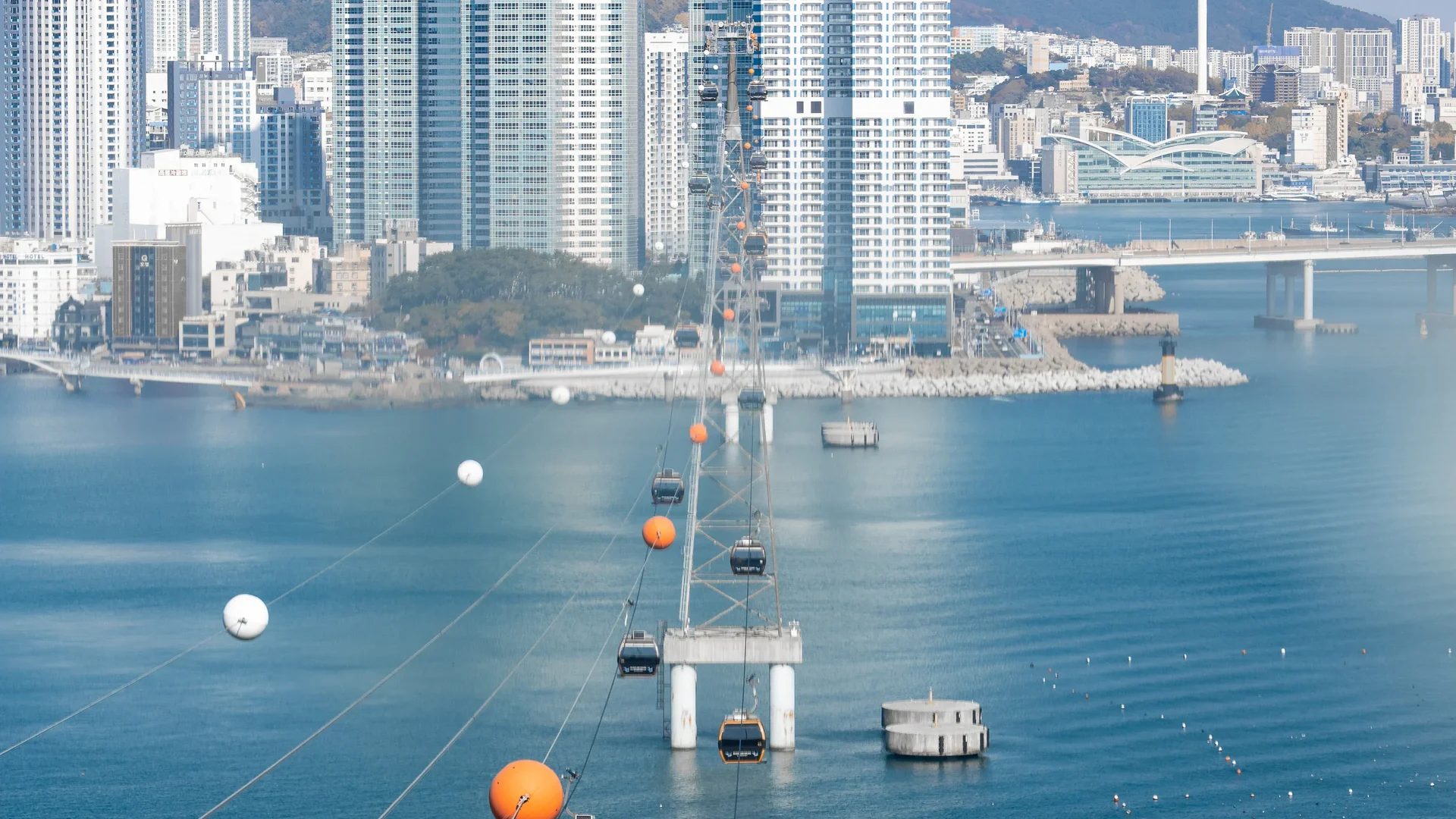
Exciting journey above the sea with eye-catching views of the coastal Busan.
The largest seafood market in Korea, where you can see all kinds of marine creatures, both from the plant and animal worlds (and from the border worlds too!).
You can also eat deliciously at the market: fried or raw fish, as well as seafood, is served at the table in numerous restaurants in the market.
If you prefer something less exotic, we recommend the food court at the Lotte department store next door. The observation deck at the department store offers a magnificent view of Busan from a bird's eye view.
Breathtaking views of downtown Busan from the seaside Lotte Department Store.
Most popular beach in Busan and a vivid resort district.
08:00
09:49 · duration, hours: approximately 3
Busan-Seoul high-speed train. the journey at speeds sometimes exceeding 300 km/h will take about 3 hours
A group transfer (without a guide) is included in the program. A Korean-speaking driver will be waiting for guests at the hotel.
You are welcome to extend your stay in Korea beyond the official end of the program. Upon request, we can assist with booking extra nights at the hotel after the tour.
Practicalities
Final room configuration is at hotel discretion; equivalent room types may be substituted without prior notice. Sleeping capacity is guaranteed; specific bed configuration is not.
Where you go
Good to know
Licensed guides. Authentic cultural experiences. Trusted by travel agents since 2013.