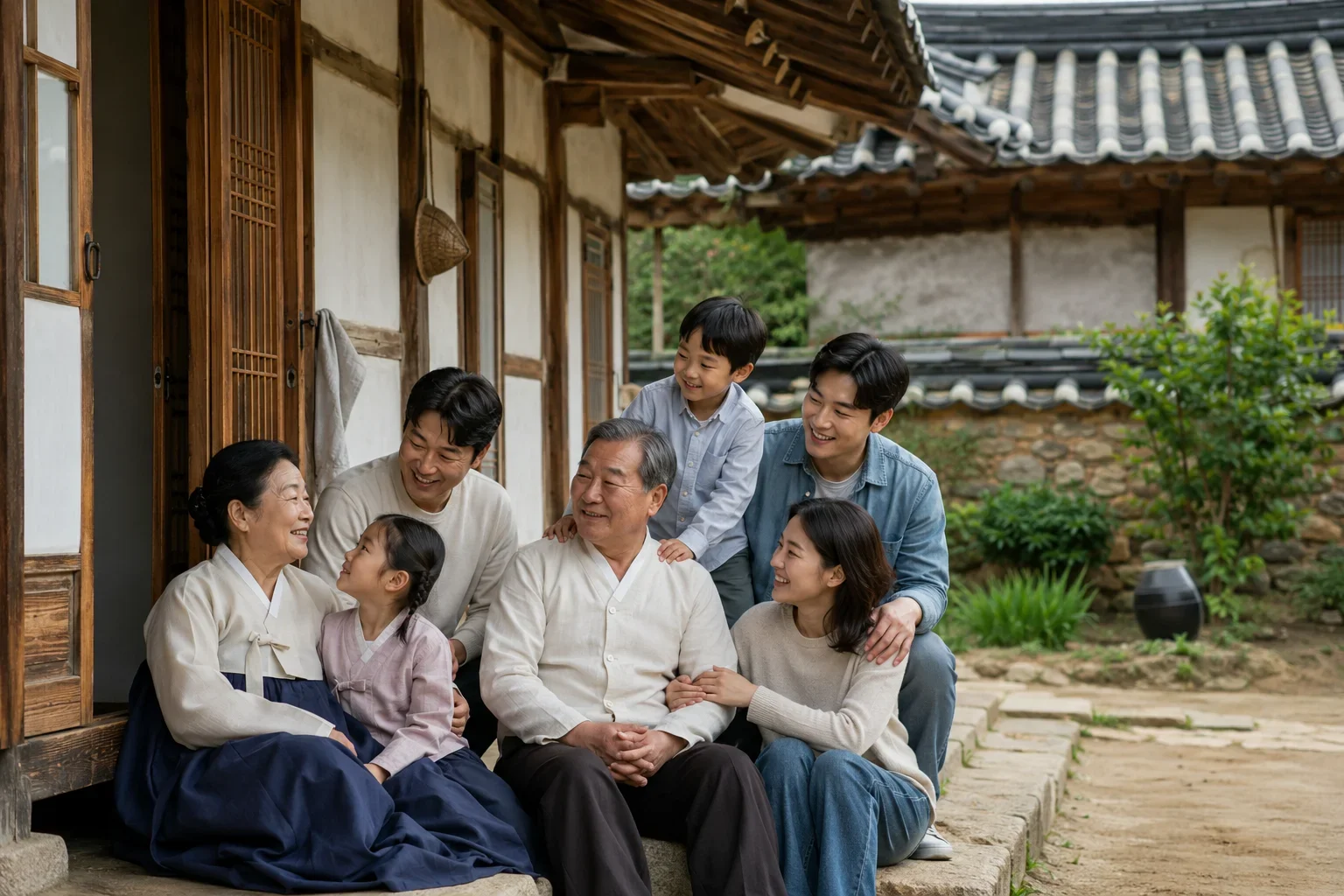
We love sharing the kinds of details about Korea that only come into focus once you've spent real time here — and few things are as quietly fascinating as the way Koreans think about, count, and address their families. Whether you're preparing for a long stay, learning Korean, or simply curious about what makes Korean social life tick, this guide covers the essentials.
Chonsu (촌수): Measuring Kinship by Number
Korea has a beautifully logical system for mapping family distance. Every relationship has a number — chonsu (촌수) — and that number tells you exactly where someone sits in the family tree.
- Spouses: 0 chonsu (무촌) — no distance at all.
- Parent–child: 1 chonsu.
- Siblings: 2 chonsu.
- Niece or nephew: 3 chonsu.
- First cousins: 4 chonsu (사촌).
The number goes up as the relationship gets more distant. You'll hear Koreans say "우리는 사촌이야" — "we're sa-chon" — meaning first cousins, four steps apart. It's an elegant system with no ambiguity.
Traditional vs Modern Family: A Story of Industrialisation
The Traditional Extended Family
For most of Korean history, the extended family (확대가족, hwakdae gajok) was the norm: multiple generations living under one roof, many children, and a clearly defined responsibility structure. The eldest son (장남, jangnam) was expected to care for his parents until the end of their lives — not rotate duties with siblings, not move away. This was not merely custom; it was a moral obligation rooted in Confucian hyo (효, filial piety).
How Industrialisation Changed Everything
The shift began with industrialisation. Korea moved from an overwhelmingly agrarian society to a manufacturing economy — factories appeared in Seoul and other major cities, industrial zones (공단) drew young workers away from their home villages, and the extended family gave way to the nuclear family (핵가족, haekgajok). Couples moved to cities for work, study, or marriage, and started households of their own.
That process has continued to its logical conclusion: today, the most common household type in Korea is the single-person household (1인 가구).
Korean Household Statistics (Statistics Korea, 2022)
Household type | Share |
|---|---|
1-person household | 34.5% |
2-person household | 28.8% |
3-person household | 19.2% |
4-person household | 13.8% |
5+ person household | 3.8% |
One- and two-person households together account for more than half of all households in Korea. That is a remarkable statistic for a country where, just two generations ago, large multi-generational families were the default.
DINK Households (딩크족)
Among two-person households, a growing segment is what Koreans call 딩크족 (dingk-jok) — couples with Double Income and No Kids. They may choose not to marry at all, or to marry but not have children. The trend reflects rising living costs, changing personal priorities, and a broader questioning of traditional family roles.
What Single-Person Households Changed in the Market
The rise of solo living has reshaped everyday commerce in ways visitors can actually observe in Korean supermarkets and home-goods stores:
Sector | Past | Today |
|---|---|---|
Housing | Large apartments preferred | Small apartments (33–66 m²) in demand |
Grocery stores | Sold goods in bulk / by the case | Individual portions and small-pack sales dominate |
Home appliances | 10–12-person rice cookers popular | 3-person mini rice cookers are bestsellers |
If you've noticed individually packaged single servings of kimchi, fruit cups, and single-serve instant noodle portions in Korean convenience stores — now you know why.
Korean Address Terms (호칭): Why There Are So Many
Korean has a richly developed system of address terms (호칭, hoching). Visitors often find the complexity daunting, but the reason is historical: during the Joseon Dynasty (조선시대), Korea was a Confucian state in which calling someone by their given name was considered deeply disrespectful — calling the king by his name was a punishable offence. Instead, people used ho (호, 號) — a kind of courtesy name or pen name, assigned at different life stages (childhood, marriage, old age). That culture of naming-by-title percolated down through the centuries and into everyday Korean speech.
It's why you can address a restaurant worker as sajangnim (사장님, "owner"), imo (이모, "aunt"), ajumma (아주머니, "ma'am"), eonni (언니, "older sister"), or simply yeogi-yo (여기요, "over here!") — and all are socially appropriate depending on context. The kinship vocabulary is just one branch of this vast address system.
Between Husband and Wife
Korean couples don't typically use each other's given names. Standard spousal address terms include:
- 여보 (yeobo) — the most common, roughly equivalent to "darling" or "honey."
- 당신 (dangsin) — more formal; also used in arguments.
- (Child's name) 아빠 / 엄마 — once a couple has children, addressing each other as "Dad" or "Mum" is extremely common.
⚠️ Note: Aebiya (애비야) and aemiya (애미야) are not spousal terms. These are what parents-in-law use to address a son or daughter-in-law who already has children. Using them between spouses would sound odd and incorrect.
Addressing Your Spouse's Parents
Who | Addressing | Term |
|---|---|---|
Wife → husband's parents | Father / Mother | 시아버지 / 시어머니 (or formally: 아버님 / 어머님) |
Husband → wife's parents | Father / Mother | 장인어른 / 장모님 (or: 아버님 / 어머님) |
Addressing Your Spouse's Siblings — The Asymmetry
This is where it gets genuinely intricate. The terms used by a wife to address her husband's family are entirely different from those used by a husband to address his wife's family — a structural asymmetry that reflects older Confucian notions of family hierarchy.
Relationship | Husband → wife's family | Wife → husband's family |
|---|---|---|
Older brother | 형님 (hyongnim) | 아주버님 (ajubeonim) |
Older sister | 처형 (cheohyong) | 형님 (hyongnim) |
Younger brother | 처남 (cheonam) | 도련님 (doryonnim) |
Younger sister | 처제 (cheoje) | 아가씨 (agassi) |
The Direction of Change: Gender Equality
Modern Korean society increasingly advocate for removing the asymmetry between terms for the husband's and wife's family sides. The direction of change is explicitly framed as gender equality (양성평등): why should a wife's family have one set of terms while a husband's family has another?
The Vocabulary of "Us": Uri and Sikgu
Two words capture something deep about Korean family culture.
우리 (uri) literally means "our" or "we," but Koreans use it where English speakers would say "my" — uri jip (우리 집) means "my house," uri omma (우리 엄마) means "my mum." Even a person living entirely alone refers to their home as uri jip. The word dissolves the boundary between individual and community.
식구 (sikgu, 食口) — literally "mouths that eat together" — is an alternative word for family. The characters mean food (食) + mouth (口). Family is defined not by blood law or paperwork, but by shared meals. This connects directly to the Korean greeting "밥 먹었어요?" (bap meogeosseoyo? — Have you eaten?) — not a literal question about food, but a way of expressing care and connection, an oral handshake that says: you are part of my world.
Korea's family culture is changing fast — but the language it uses to talk about family is, in its own way, a living archive of everything that came before.
Korean cuisine and food culture are not only diverse in taste but also rich in linguistic nuances. Terms like "yori" (요리), "eumsik" (음식), "siksa" (식사), and "anju" (안주) may seem similar, but their meanings differ significantly depending on the context. Let’s explore how these words are used in everyday life and restaurant menus.
Korea is beautiful at any time of year – but each of them offers something special. In the spring, cherry blossoms bloom, in the summer, beaches open, in the fall, gold in the mountains, and in the winter, ski resorts await. In this article, we tell you when is the best time to go in 2025 – taking into account the weather, key events and seasonal prices for tours.